No products in the cart.
Uncategorized
Why Lab Managers and Engineers Trust U.S.-Built Mixers for Hazardous Applications

19
Dec
Dec
In chemical engineering labs and cosmetic R&D spaces, hazardous conditions are usually routine: solvent vapors near a drum lid, a lacquer blend flashing off, or a resin that thickens until the mixer starts to strain. Choosing the right equipment comes down to specifics, including how the drive behaves around vapors, how speed is controlled, and what materials are in contact with the batch. For teams responsible for hazardous material mixing, those details affect more than process efficiency; they influence operator safety, batch consistency, and equipment longevity. The sections below explain the practical reasons many teams rely on U.S.-built air mixers and industrial stirrers from Arrow Mixing Products when the chemistry is volatile, and the process has little tolerance for surprises.
Intrinsic Safety Beats Careful Operation Every Time
Hazardous mixing is not only about what is in the vessel. It is also about what happens around it: flammable vapors, combustible solvents, and processes that can look stable early in the day but shift after temperature drift, viscosity changes, or repeated openings.
Pneumatic air mixers remove one of the biggest concerns in these environments: electricity at the motor. Because pneumatic mixers use compressed air to generate rotational force, they reduce ignition risk at the drive in many hazardous scenarios where flammable vapors may be present. Arrow positions air mixers as a safer choice for volatile chemicals, solvents, lacquers, and other flammable solutions for this exact reason.
That difference is practical. It can make it easier to standardize mixing across stations and reduce the need for workarounds that exist mainly to compensate for equipment that is not naturally suited to hazardous applications. In many industrial mixing applications, that built-in advantage matters because safer mixer design can support better day-to-day handling of combustible and solvent-based materials without adding unnecessary complexity to the workflow.
Repeatability and Control Are Practical Safety Features
In hazardous applications, repeatability is not only about quality. It helps prevent the process from wandering into a more dangerous operating zone. If agitation drifts, a batch can separate, thicken, trap heat, or force more hands-on correction. More manual intervention often means more risk.
Arrow’s pneumatic overhead stirrers use a needle valve for speed control, giving operators straightforward adjustment without adding electronics to the mixing head. Arrow also notes that its air mixers can deliver high torque with adjustable speed control across a range of mixing applications, including high-viscosity materials.
In day-to-day terms, this means teams can dial in a target mixing window and return to it batch after batch. It also helps during scale changes, when a process moves from a smaller vessel to a covered container and the operator relies more on feel, sound, and shaft behavior than on clear visibility. That level of control is especially valuable in hazardous material mixing, where stable agitation can help reduce process variability and support safer handling of sensitive, flammable, or high-viscosity batches.
Practical Details That Keep the Mixer Running
In hazardous environments, reliability is not a nice-to-have. It affects scheduling, staffing, and whether a batch can be finished without rushed changes. Arrow points to a few features and setup practices that help air mixers run consistently and reduce avoidable wear.
- Use a Filter/Regulator and an Air-Line Lubricator: Clean, regulated air and proper lubrication help the air motor run smoothly and last longer. Without them, performance can become inconsistent, and components can wear out faster.
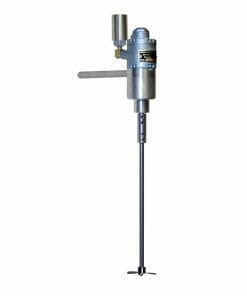
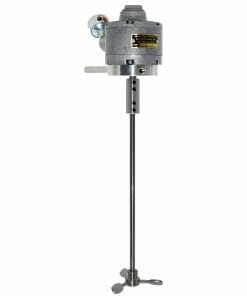
- Standard included Hardware Supports a Faster, Cleaner Setup: Arrow’s explosion-proof air-driven mixers typically come with an aluminum support rod, a four-foot air hose, and a 316 stainless steel shaft and propeller. That means fewer extra pieces to source and less improvising when a mixer needs to move between vessels.
Materials matter, too, because chemical resistance is not optional in volatile work. Arrow highlights corrosion-resistant shaft and propeller, options such as stainless steel and PTFE, depending on the model and need.
Mixers That Can Adapt to Lab Setup Changes
A lot of mixer content assumes a perfect setup: one dedicated tank, a fixed mount, and plenty of room. That is not how most labs and pilot areas operate. One day, a mixer is clamped to a drum for a quick blend. The next day, it is on a stand next to a tote, wedged between a fume hood and storage.
Arrow’s air mixers are designed for that reality. There are clamp-mount and stand-mount options for drums, tanks, and totes, including options meant for corrosive applications. The product line also includes gear-drive and direct-drive models, so teams can choose what fits the material and the goal, whether the job needs more torque for thicker batches or higher speed for lighter solutions.
Those model differences matter when an application shifts. With multiple air mixer options across duty levels and maximum RPMs, engineers can select the best fit instead of forcing one mixer into every scenario. The result is less “make it work” setup, fewer vibration issues, and fewer operator workarounds.
Supply Chain Trust and Support That Holds Up in the Real World
A hazardous application is not the moment to discover a long lead time, unclear documentation, or a vendor that cannot answer practical questions about configuration and parts. Many lab managers value U.S.-built equipment because it often comes with fewer logistics variables and more direct access to people who know the products.
Arrow states that it manufactures industrial mixers in-house and keeps listed mixers in stock, which supports faster fulfillment without customs delays. Arrow also backs purchases with a 30-day satisfaction guarantee and a one-year warranty. For teams managing hazardous applications, that combination supports more predictable planning and easier internal approval. For buyers sourcing industrial agitators and mixer accessories in the U.S., that kind of availability can make it easier to keep projects moving without long interruptions or uncertain replacement timelines.
Need Help Selecting a Mixer?
If a facility is mixing volatile chemicals, solvents, lacquers, or other flammable solutions, the best approach is usually the one that reduces ignition risk, stays consistent under load, and is built with materials that match the application. To view Arrow’s current air mixers, compare options for different applications, and get product information from a team that can help match a mixer to the process, contact Arrow Mixing Products or explore the air mixers product category online.
