No products in the cart.

Uncategorized
How to Choose the Right Impeller for a Mixing Application?
18
Aug
Aug
Key Takeaways
- Start with the mixing goal: blending, suspension, dispersion, or circulation.
- Consider viscosity before choosing impeller size and style.
- Match the impeller to the vessel, shaft, and available mixer torque.
- Choose materials that can handle the chemicals and conditions in your process.
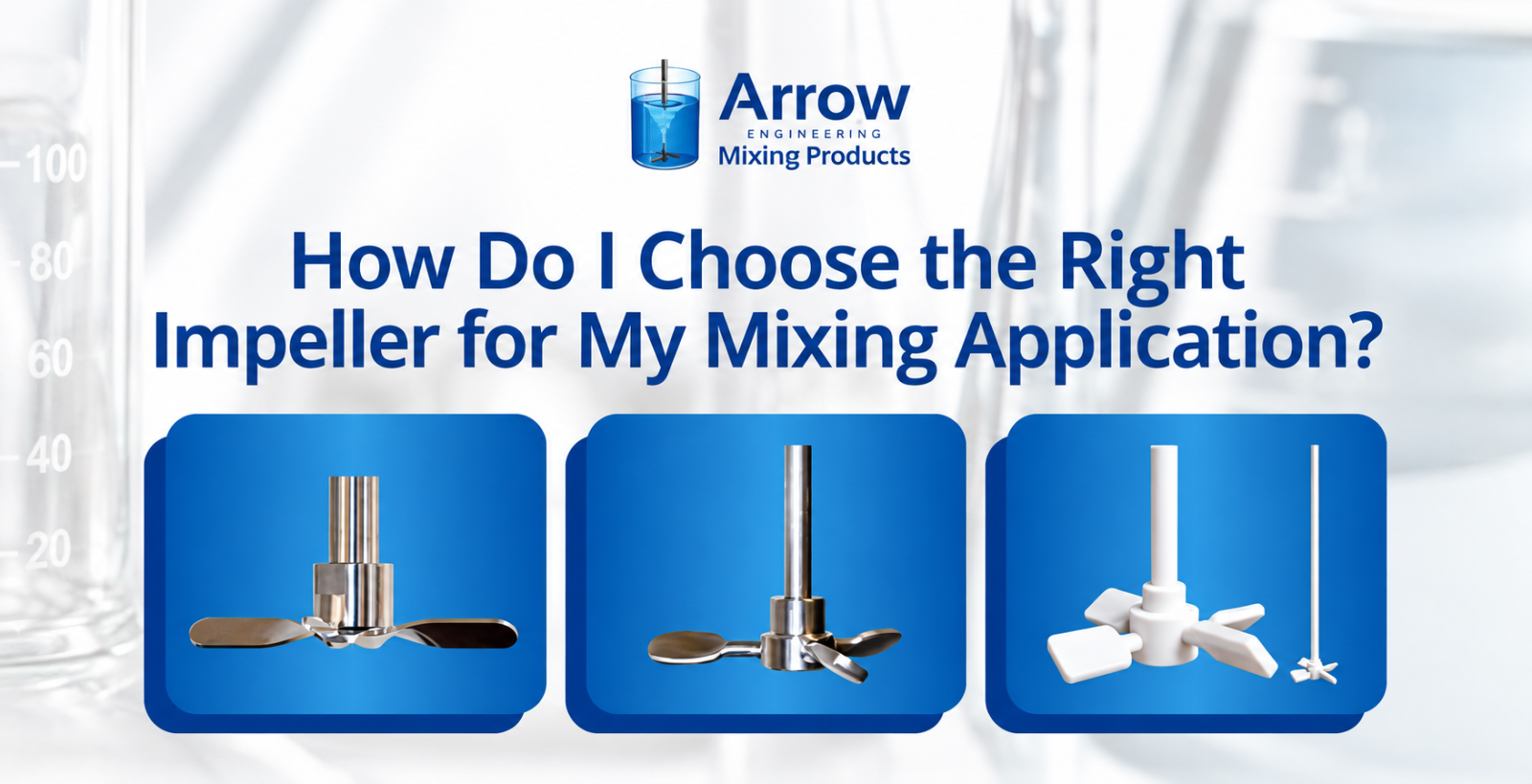
The mixer motor gets a lot of attention, but the impeller is what actually moves material through the vessel. Depending on the design and application, this mixing component may also be referred to as a propeller. Arrow Mixing Products uses both terms across its mixing equipment and accessories. Choosing the wrong one can leave you with dead zones, poor dispersion, longer mixing times, or inconsistent batches even when the mixer itself has enough power.
The right impeller depends on what you are mixing, how thick the material is, the size and shape of the vessel, and what you need the mixing process to accomplish.
Start With the Mixing Goal
Before choosing an impeller, define what needs to happen inside the vessel. Are you blending two liquids? Keeping solids suspended? Breaking apart agglomerates? Moving heat through the batch?
The University of Michigan’s Visual Encyclopedia of Chemical Engineering Equipment explains that impeller selection depends on factors such as vessel geometry, viscosity, and rotational speed, with designs generally producing axial or radial flow.
Axial flow moves material primarily up and down through the vessel, making it useful when strong top-to-bottom circulation is important. Radial flow pushes material outward toward the vessel walls and can provide higher shear for applications such as dispersion. The University of Michigan also notes that axial-flow impellers are often useful for solid-liquid suspension, while radial-flow designs can be better suited to high-shear applications.
The goal is not simply to create visible movement in the vessel, but to choose a propeller or impeller design that produces the type of flow the process requires.
Consider the Viscosity of the Material
A thin liquid behaves very differently from an adhesive, coating, gel, or heavy slurry. As viscosity increases, the impeller has to work harder to move material through the vessel.
High-viscosity applications generally need more torque and may require a larger impeller or a design that moves more material at lower speed. Simply increasing RPM is not always the answer. Too much speed can create a vortex or introduce air without improving overall circulation.
This is why impeller selection should be considered alongside mixer speed and torque. Our guide to torque, speed and viscosity explains how these variables work together when selecting an industrial mixer.
Match the Impeller to the Vessel and Mixer
Impeller diameter, shaft length, and placement all affect how well material circulates. An undersized impeller may create plenty of movement near the blades while leaving material near the walls or bottom relatively untouched.
The impeller also needs to be compatible with the mixer’s available torque and the shaft being used. Arrow offers mixer accessories including shafts, couplings, and propellers that can be matched to different laboratory and light-production setups. Changing the shaft length, propeller or impeller style, or coupling can also change how material moves through the vessel, making these components an important part of the overall mixer setup.
Do Not Overlook Material Compatibility
The impeller material matters when working with corrosive chemicals, food products, or other demanding materials. Arrow’s Type 316 stainless steel propellers provide corrosion resistance for a wide range of laboratory and industrial applications. PTFE shafts and propellers are another option for processes involving highly corrosive or caustic materials.
Find the Right Impeller for Your Application
No single impeller is right for every mixing process. Choosing the best option requires looking at how the entire system operates, from the material being mixed and the size and shape of the vessel to the flow, speed, and power needed to achieve consistent results.
If you are unsure which setup fits your process, Arrow Mixing Products can help you match the mixer, shaft, and impeller to your application. Browse Arrow’s propellers and mixer accessories or contact the team for help building a more consistent mixing setup.
